


Optyma A.I. by Oliver Agro: automatic inter-row and in-row weeding machine on a side-shift frame, with artificial intelligence plant recognition and 2.0 A.I. or ECO A.I. units
In brief: the Optyma A.I. by Oliver Agro is an automatic in-row weeder: it hoes between plants and between rows in the same pass. On each unit an A.I. camera recognises the crop plants and distinguishes them from weeds; the automatic knives open around the plant and hoe at a depth of 2–3 cm. It works with row spacings from 18 to 225 cm, minimum in-row spacing 12.5–15 cm, typically at 1.2–1.5 km/h and up to 5 km/h: speed depends on the crop and the in-row spacing.
Two unit versions. Optyma 2.0 A.I.: hydraulic self-levelling on the unit. Optyma ECO A.I.: gauge wheels on the unit. Same vision system and same automatic knives.
Hydraulic system. The Optyma A.I. connects to the tractor in two ways: with a Load Sensing connection, if the tractor has a variable displacement pump, or with an independent hydraulic system, when the tractor does not have enough oil flow. The system is proportional and PLC-controlled: it keeps depth constant to within ±3 mm. The frame side-shift and knife control circuits are separate, so plant recognition keeps working even while the frame is shifting.
When to choose it. When you need to clean between plants, when you grow several crops with different planting patterns or when the farm already has inter-row hoeing machines. It is the recommended version for fennel. It is designed to work mainly at an early growth stage, to prevent weed infestation. The machine can go in 10 days after transplanting, ensuring complete cleaning in the in-row too. The version with the Tillett & Hague camera is the Optyma weeding machine.
Crops. Lettuce, radicchio and sugarloaf chicory, cabbage, savoy cabbage, broccoli, cauliflower, chard, fennel, celery, pumpkin and other head and leaf vegetables, transplanted onion, seed beet, sugar beet, processing tomato, aromatic herbs, maize; transplanted or drilled, on the flat or on beds. 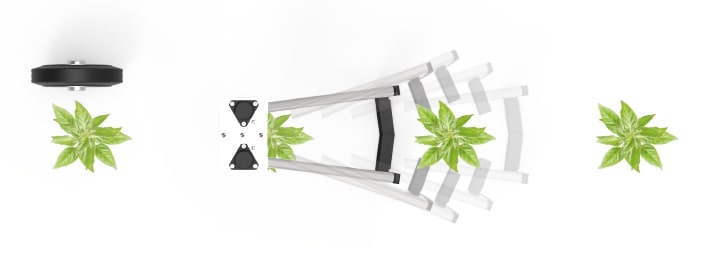
How the Optyma A.I. is built
| Subsystem | Components | Function |
|---|---|---|
| Vision | Per row: 1 2D camera, 2 3D cameras, LED flash lighting, dedicated A.I. computing module | Recognises the crop, calculates its root point, reads plant and soil height |
| Central unit | Power box with GPS and connectivity, Android tablet via WLAN | Crop management, system status, diagnostics, updates |
| Unit | Parallelogram, knife carrier with L/R knives, hydraulic cylinder with solenoid valve, side hoes and flex spring | Works the row: knives between plants, hoes in the inter-row |
| Depth control | 2.0 A.I.: hydraulic self-levelling · ECO A.I.: gauge wheels | Constant depth of 2–3 cm |
| Frame | Side-shift TT12 or TT25, fixed 3-point section + moving section on chrome-plated bars | Lateral alignment of the units to the row |
| Hydraulics | Load Sensing (variable displacement pump) or independent system; proportional, PLC-controlled | Separate circuits for frame side-shift and actuators |
Vision system
- Root point recognition. The A.I. model assigns each plant a single coordinate, the point where it emerges from the soil, rather than the outline of its leaves. The result is not affected by wind, by overlapping leaves between neighbouring plants or by weeds under the canopy.
- 3D reading. The two 3D cameras measure plant and soil height: the system distinguishes the crop from weeds even when they are the same colour.
- Own lighting. The LED flashes make the image independent of ambient light: the same result with low sun, overcast skies and at night. No colour calibration.
- Trained crops. Over 190 plants in the model; new crops are trained from field images. Operational from the 2-leaf stage.
Labour savings
Hand weeding in the row takes 40 to 230 hours per hectare depending on the crop. The Optyma A.I. does the same job in a few hours and removes 78 to 97% of the weeds in the row.
| Crop | Example configuration | Hand-weeding h/ha | h/ha with Optyma A.I. at 1.5 km/h | Hours saved per hectare |
|---|---|---|---|---|
| Lettuce | 6 rows at 30 cm | 200 | approx. 4 | approx. 196 |
| Pumpkin | 3 rows at 140 cm | 40 | approx. 1.7 | approx. 38 |
Machine hours calculated on working width × 1.5 km/h, with 4 minutes per hour for headland turns. At higher speeds, where the crop allows, the hours drop further. Hand-weeding hours and percentage of weeds removed: 2026 field data for the vision system.
Precision between plants
- Minimum in-row spacing 12.5–15 cm: the knives work between two plants even at this distance.
- Root point reference: the knife opens relative to the point where the plant emerges from the soil, not to the edge of its leaves. The safety distance from the plant stays the same even on plants of different sizes. Especially in windy conditions and when the plant is still fragile.
- Constant depth of 2–3 cm: with self-levelling (2.0 A.I.) or gauge wheels (ECO A.I.) the knife does not go below the crown or rise out of the soil. On the 2.0 A.I., depth is read by a mechanical feeler that touches the ground: it stays accurate even when the inter-row is covered with weeds, where the camera’s 3D reading alone cannot see the soil and gets the depth wrong.
Unit: two versions
| Optyma 2.0 A.I. | Optyma ECO A.I. | |
|---|---|---|
| Photo |  |
 |
| Depth control | Self-levelling: front feeler with angle sensor + hydraulic upright with linear potentiometer, ±150 mm travel. Accurate depth even with the inter-row covered with weeds | Gauge wheels on the unit |
| When to choose it | Uneven soil, irregular beds, maximum depth consistency, when the outer transplanted row is at the edge of the bed or on very sandy soil | Level soil, evenly spaced rows, room between the bed edge and the last transplanted row for the gauge wheel. |
| Inter-row | Side hoes and flex spring | Side hoes and flex spring |
| In-row knives | Knives on a knife carrier, opening controlled by the vision system | Knives on a knife carrier, opening controlled by the vision system |
The knives enter the soil at 2–3 cm, open when they reach the plant and close again immediately after, working the stretch of row between one plant and the next. The knife carrier is driven by a hydraulic cylinder controlled by a solenoid valve: fast opening and closing even on compacted soil.
Frame and alignment
Side-shift frame in two sections: the fixed section is hitched to the tractor’s 3-point linkage, the moving section carries the units and shifts on chrome-plated bars with hydraulic cylinders.
- TT12 — ±150 mm side-shift on 2 Ø50 mm bars with bronze bushes; 2,380 mm toolbar, also double; 2 depth wheels 400 × 150 mm with 6 cm rib; for machines up to about 950 kg.
- TT25 — 500 mm side-shift (±250) on Ø60 mm chrome-plated bars, 2 separate rams; also with double toolbar; version with 2 depth wheels or 4 support wheels, with the weight carried by the ground and the top link not loaded; for heavy machines. The frame can also be front-mounted on the tractor
Software, data and support
- Crop selection and diagnostics from the tablet; no field calibration.
- Remote software and A.I. model updates, remote monitoring and support. The connection is needed for updates and support, not for working.
Technical data
| SOIL TYPE | Sandy, medium loam, also stony; level soil |
| ROW SPACING | 18 – 225 cm |
| IN-ROW SPACING | Minimum 12.5 / 15 cm |
| PLANT RECOGNITION | Artificial intelligence vision system, one camera per unit |
| UNIT | 2.0 A.I.: hydraulic self-levelling · ECO A.I.: gauge wheels |
| WORKING SPEED | Typically 1.2 – 1.5 km/h, up to 5 km/h depending on crop and in-row spacing. Knives with hydraulic actuator: from 2027 new actuator with 5 open/close cycles per second |
| FRAME | Side-shift TT12 or TT25 (longer), rubber support and transport wheels |
| REQUIRED SOIL PREPARATION | Level soil (stone burier, bed former with smooth levelling roller) |
| HYDRAULIC SYSTEM | Load Sensing (tractor with variable displacement pump) or independent hydraulic system; separate circuits for side-shift and knives |
| SYSTEM TYPE | Automatic |
Frequently asked questions
Is there a weeding machine with artificial intelligence?
Yes. The Optyma A.I. by Oliver Agro recognises each plant with an A.I. vision system and hoes between plants with automatic knives.
What is the difference between Optyma 2.0 A.I. and Optyma ECO A.I.?
Same machine and same A.I. system; the 2.0 A.I. has hydraulic self-levelling on the unit, the ECO A.I. has gauge wheels.
How does it differ from the Optyma?
The Optyma recognises plants with the Tillett camera, the Optyma A.I. with artificial intelligence.
What row spacing does it work at?
From 18 to 225 cm.
Does it work on fennel?
Yes, the Optyma A.I. is recommended for fennel.
Do I need a tractor with Load Sensing?
No. The Optyma A.I. connects via Load Sensing if the tractor has a variable displacement pump; alternatively it is supplied with an independent hydraulic system.
How does it tell the crop from the weeds?
With an A.I. model trained on the crop and the weeds, which locates the root point and uses a 3D height reading.
What happens with overlapping leaves or weeds under the plant?
The reference is the root point, not the canopy: the plant position remains correct.
From what stage can it work?
From the 2-leaf stage.
What does the speed depend on?
On the crop, the distance between plants in the row and the soil. Each plant requires one open/close cycle of the knives: with the new actuator at 5 cycles per second you reach 2.7 km/h at 15 cm in-row spacing, 4.5 km/h at 25 cm and 5 km/h, the machine maximum, from 30 cm upwards. The faster you go, the more soil is thrown onto the plant: on leaf crops, soil in the head causes rot and disease. On crusted soil the clods must be crumbled, and if they are thrown onto the plant the speed must be reduced. That is why speed is checked in the field with the customer; typical working speed is 1.2–1.5 km/h.
Does it need an operator on board?
No: the vision system controls the knives and the side-shift frame keeps the alignment.
Does it need calibrating for each field or different light?
No: it has its own lighting, no colour calibration.
Does it work if the inter-row is full of weeds?
Yes. On the Optyma 2.0 A.I., depth is not estimated by the camera but read by a feeler that touches the ground: with the inter-row covered with weeds, the knife stays at the right depth.
Does it work on crusted soil?
Yes, as long as the clods broken by the knives are crumbled. If clods end up on the plant, speed is reduced.
Can crops be added?
Yes, the model can be trained on new crops from field images.
Why choose an Oliver Agro weeding machine?
Oliver Agro, founded in 1978, has been making hoeing machines in Italy since 2007 and was the first company in the world to build steel rotors for hoeing, with the patented Rotosark® system. It knows the sector and growers’ problems thanks to its experience in open fields, greenhouses, horticulture and broadacre crops. The range covers row spacings from 4.5 to 80 cm on the flat, on beds and on ridges, and every machine is configured to order: soil type, row and plant spacing, weed growth stage relative to the crop and how close to the plant you want to work are all assessed, to reduce or eliminate manual weeding.


